Chemistry you watch emerge.
Aufbau keeps no library of molecules and no list of reactions. Give it atoms and it computes how they bond, plans a multistep synthesis, and — on a single energy principle — carries all the way to the nucleus.

It stores nothing it can compute.
Most learning software shows you an answer pulled from a database of results. Aufbau keeps no such database — the only things it stores are the handful of measured nuclear values no simple formula gets right. A structure appears because it minimizes an energy score under each atom's valence; a reaction proceeds because a search finds a downhill path to the target. Behavior you watch emerge from a principle is understood more deeply than behavior you are simply shown.
It's AI. It just doesn't guess.
The AI in the headlines is the large language model — it predicts what looks right, so it can be confidently wrong, and no two runs are guaranteed to agree. Aufbau is a different kind of AI: it computes from physical law. The same atoms always give the same result — deterministic, reproducible to the last bond, and traceable to the energy that produced it. When the physics can't decide, it says so rather than invent an answer. Nothing is sampled. Nothing is hallucinated.
Every measured isotope. The same bits on every machine.
Isotopes. Write D2O, CDCl3 or [2H] and the label stays on the atom where you put it; vibrations, entropy and zero‑point energy then use that isotope’s own mass. Each element’s page lists every isotope in the 2020 Atomic Mass Evaluation — estimates marked as estimates — and the decays that are energetically open. Checked against NIST and JANAF: the H2/HD/D2 vibrations to within 0.07%, isotope entropy shifts to within 0.11 J/(mol·K). Bit‑identical. The engine now carries its own correctly‑rounded math, so the same reaction gives the same numbers, to the last bit, on Apple silicon, on Intel, on Linux and on a Raspberry Pi. And more chemistry arrives in one move: tetrazoles, triazoles, pyrazoles, indazoles and Knoevenagel condensations. What changed, step by step → (Patent pending.)
From 15.1% to 19.2% of published chemistry — in eight days.
Aufbau’s reaction capability is growing fast, and every gain is measured, not claimed. Against 153,237 reactions published by other chemists for other reasons, the engine now predicts 29,427 exactly, molecule for molecule — 6,287 more than the version before, with about sixteen right answers gained for every one lost. It now reads what is in the flask: acids, activators and reductants are recognised from their atoms and decide which bonds may react. Aromatic rings are priced from measured heats of formation (NIST), and whole families of reactions it could not reach before — imines, oximes, hydrazones, pyrazoles, Hantzsch thiazoles — now arrive in one move. Step by step, with what each step cost → (Patent pending.)
Nothing was fitted to these reactions, and nothing in them is consulted when the engine runs. Each step was switched on and off before it shipped — including the 3,788 reactions that went the other way, from “no reaction” to a wrong answer, which the research page discloses.
Some bonds have nothing left to give.
Chemical nobility. A bond with no lone pair to donate, no π bond to attack and no group ready to leave gives an incoming reagent nothing to take hold of — so Aufbau no longer offers it to a reaction, unless the flask is hot enough for radical chemistry, where even noble bonds break. It is decided from the atoms themselves, not from a list of reactions. Measured on 153,237 published reactions: 30 right answers gained for every one lost. How we defined it, and what it cost → (Patent pending.)
Also in 1.27: carbon–carbon bonds from organometallic reagents, reactions that finish the second step a deprotonation starts, and products reported as a chemist isolates them. Every number is measured with the engine’s change switched on and off — the method, and the misses, are on the research page.
Don't look it up. Derive it.— The whole idea, in four words
From a pile of atoms to a computed route.
Atoms in.
Drop in the elements — no structure, no bonds. Just atoms and the principles every introductory course already teaches: valence, electronegativity, energy.
Energy decides.
The engine searches for the bonding arrangement that minimizes energy, discarding a branch only when it can prove that branch is worse. Covalent, ionic, metallic, aromatic — all outcomes of one comparison, not stored categories.
Structure emerges.
Molecules assemble, multistep syntheses plan themselves, and the same energy rule reaches into the nucleus. Every result traces back to the step that produced it.
It doesn't stop at one step. It computes the whole route.
Give Aufbau a mixture and it now derives the multi-step pathway to the product — each step's mechanism and its energy change, chained until the chemistry settles. When a mixture won't react, it explains why: how close it came, and what held it back. No reaction database, no templates — the route falls out of the same energy model that builds the molecules.
The proof is a reaction the world runs at megaton scale: urea — the most-produced nitrogen fertilizer on Earth — from captured CO₂ and ammonia. Aufbau derives the real industrial path, through carbamic acid to urea and water, end to end, from nothing but the atoms and the energy that binds them.
Tell it what you want. It finds what you need.
Turn the question around. Mark a reactant as a wildcard — an element with a question mark, like N? for “a nitrogen source” — name the product you want, and Aufbau reasons backward to the reagent you're missing. It doesn't scan blindly: from atom balance it derives that urea from CO₂ needs two ammonia, with water leaving, then proves it against the real reaction route.
And when the source you need isn't on your shelf, it names it anyway — the exact reactant that would work. Most tools go quiet when they can't find an answer on hand; this one turns “no” into “here's what to get.”
From atoms to entanglement — in under two minutes.
The whole story in one take: structure emerges, a synthesis plans itself, and the same energy principle reaches the nucleus — then the app computes the quantum layer beneath the chemistry, all the way to a molecular qubit and an entangled pair.
Six things you can watch it compute.
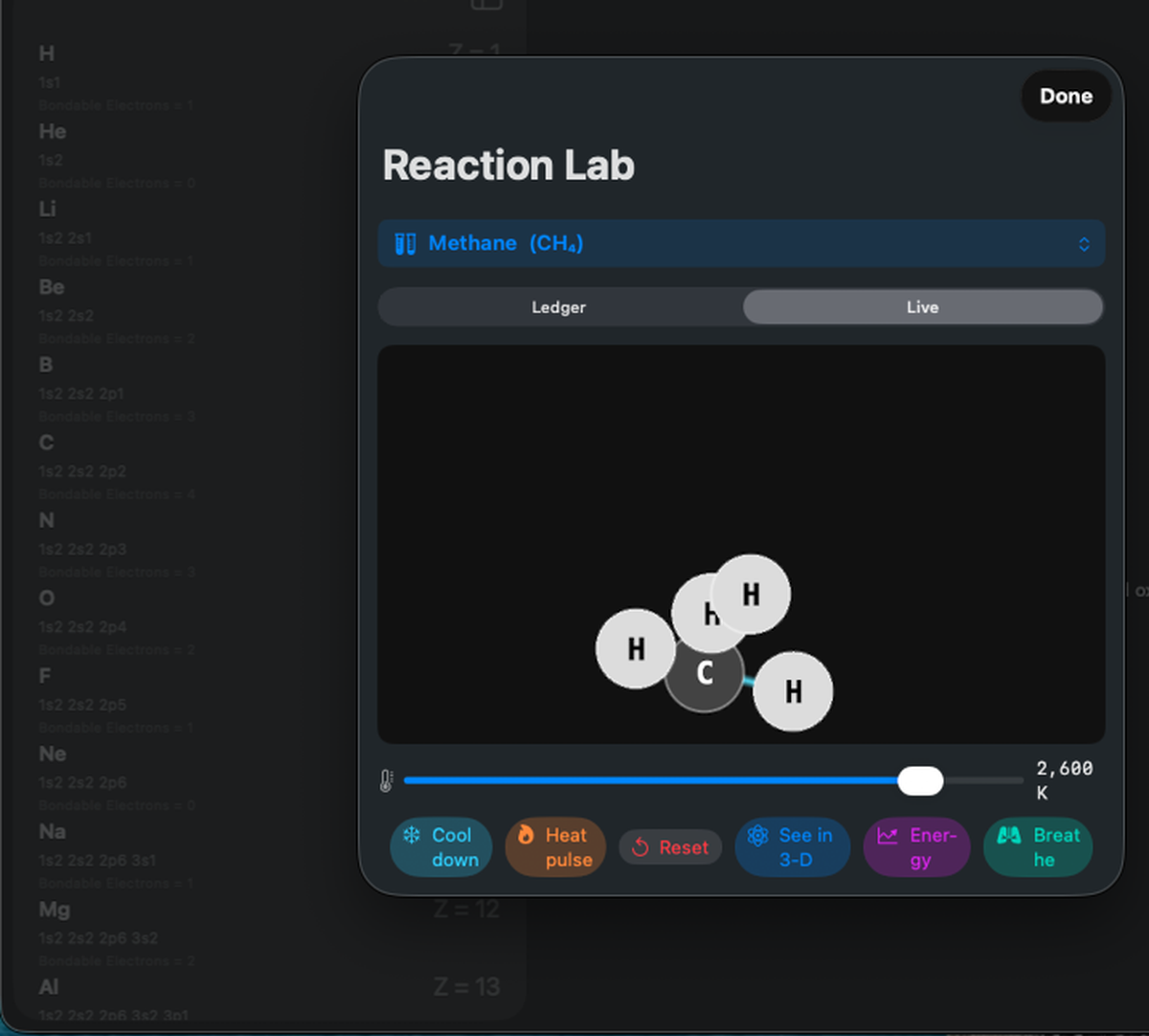
Watch molecules build from atoms
Bonds form because they minimize energy under each atom's valence — the bent water molecule, the tetrahedral carbon of methane, the alternating ring of benzene. Nothing is looked up.
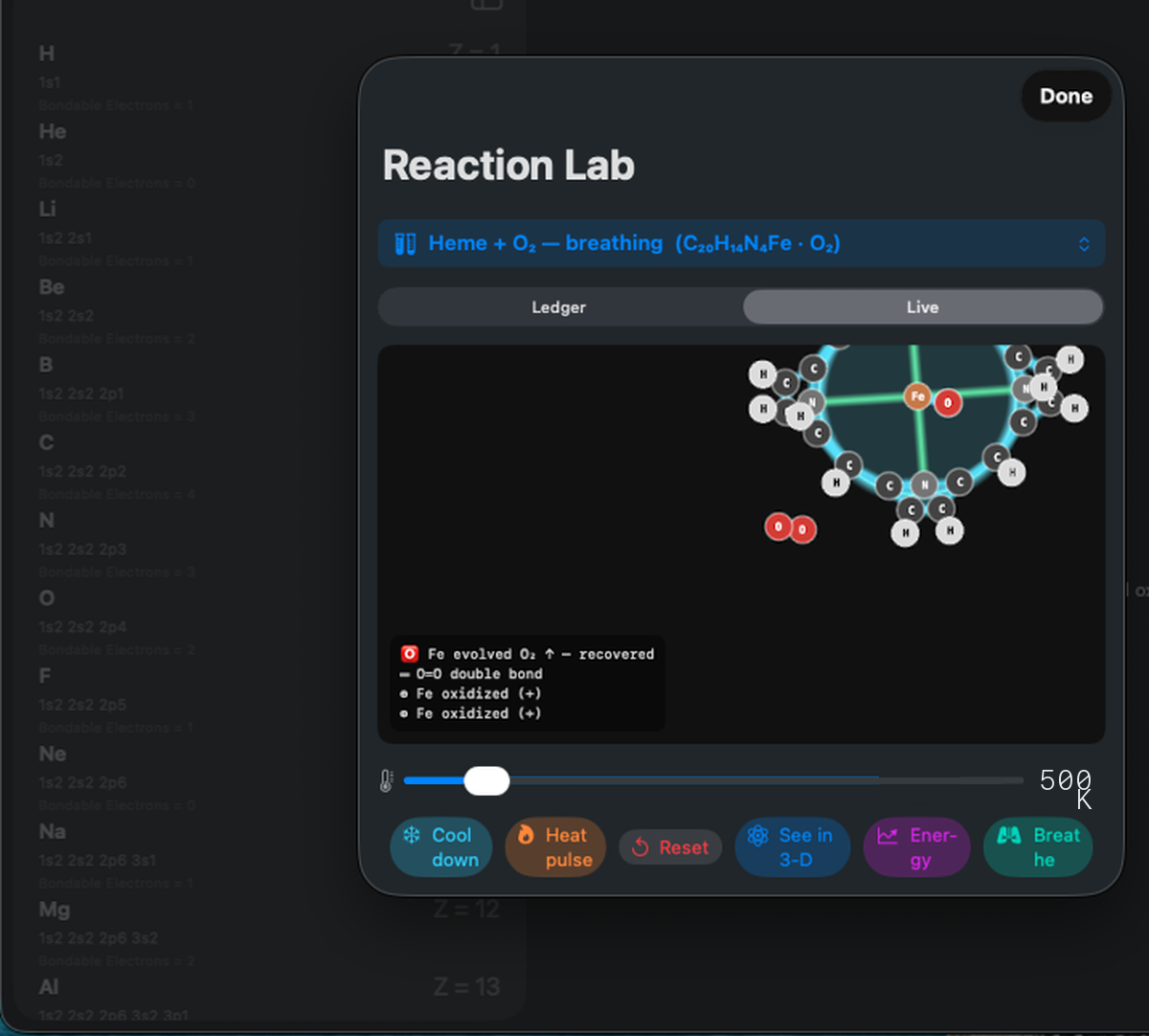
See the delocalized cloud
The Hückel rule, applied uniformly, certifies aromatic rings from benzene to the macrocycle at the heart of heme and chlorophyll — metal center and coordinate bonds and all.
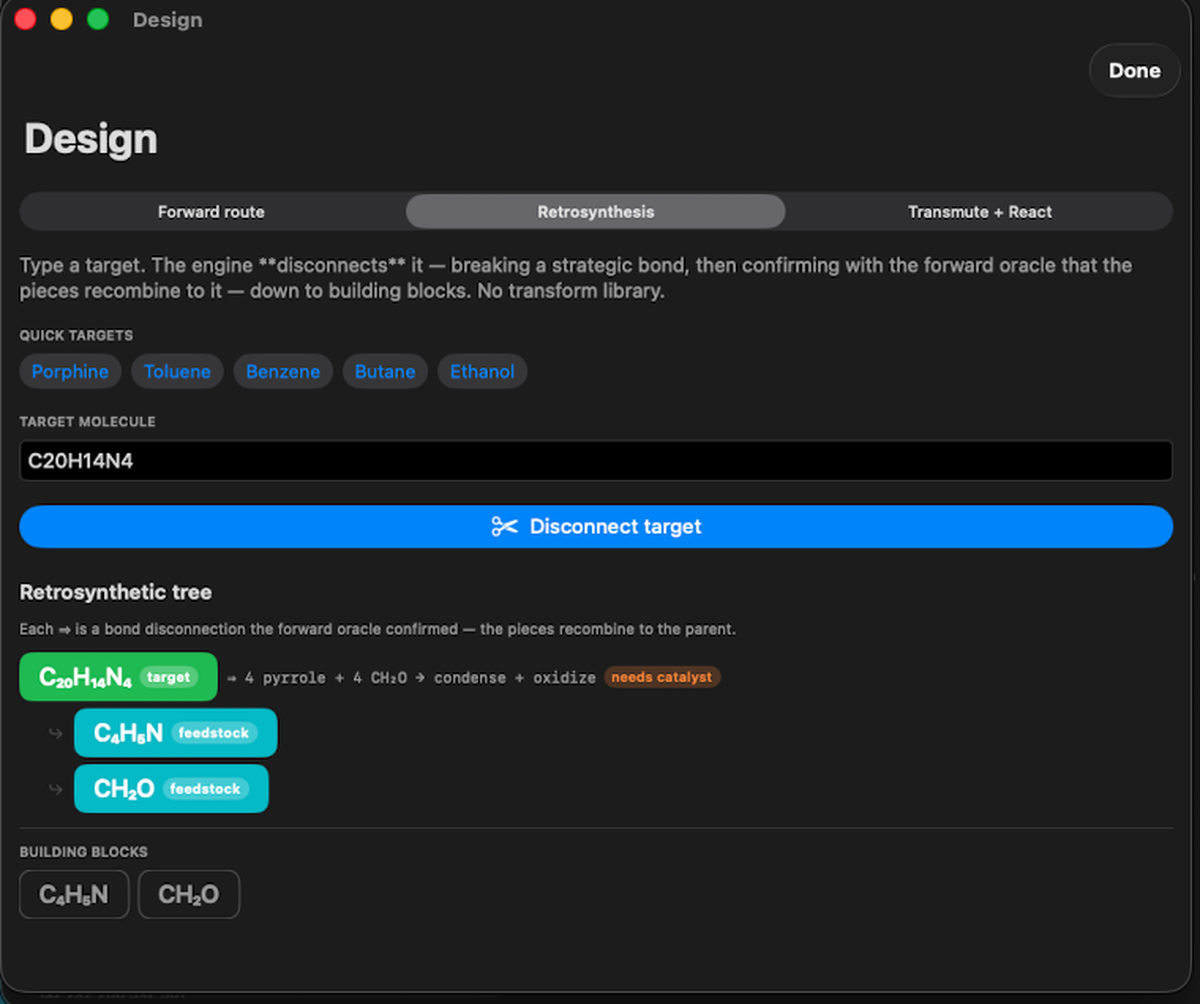
Plan a synthesis backwards
The engine proposes a strategic disconnection and validates it against the same forward model that would run the synthesis — keeping only cuts it can itself reverse. No transform library.
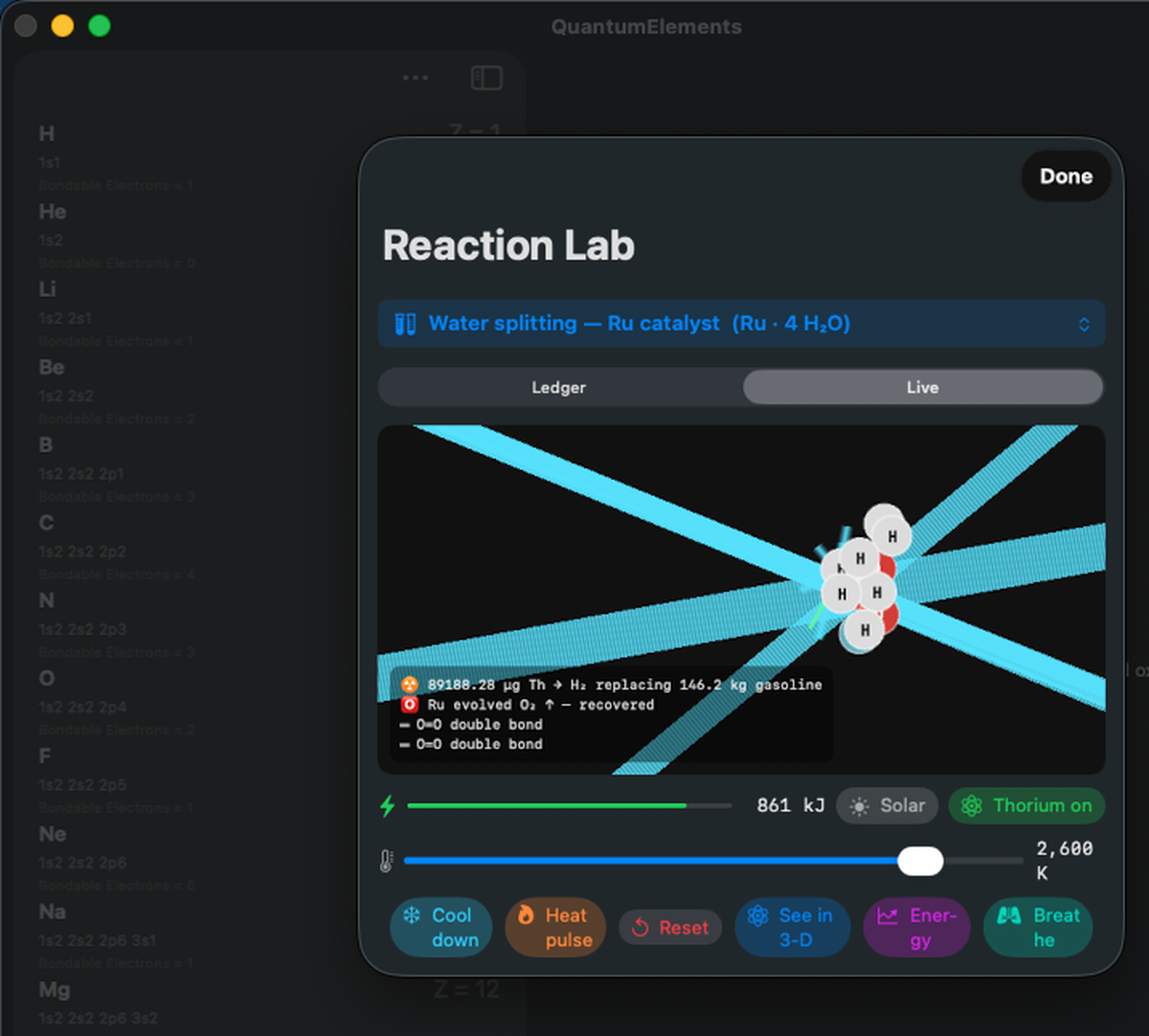
Power a reaction with a reactor
A thorium fission source drives a water-splitting cycle, and a live ledger measures the clean hydrogen it makes against the gasoline it replaces — the fission energy computed from the engine’s own physics, carried through measured heats of formation.
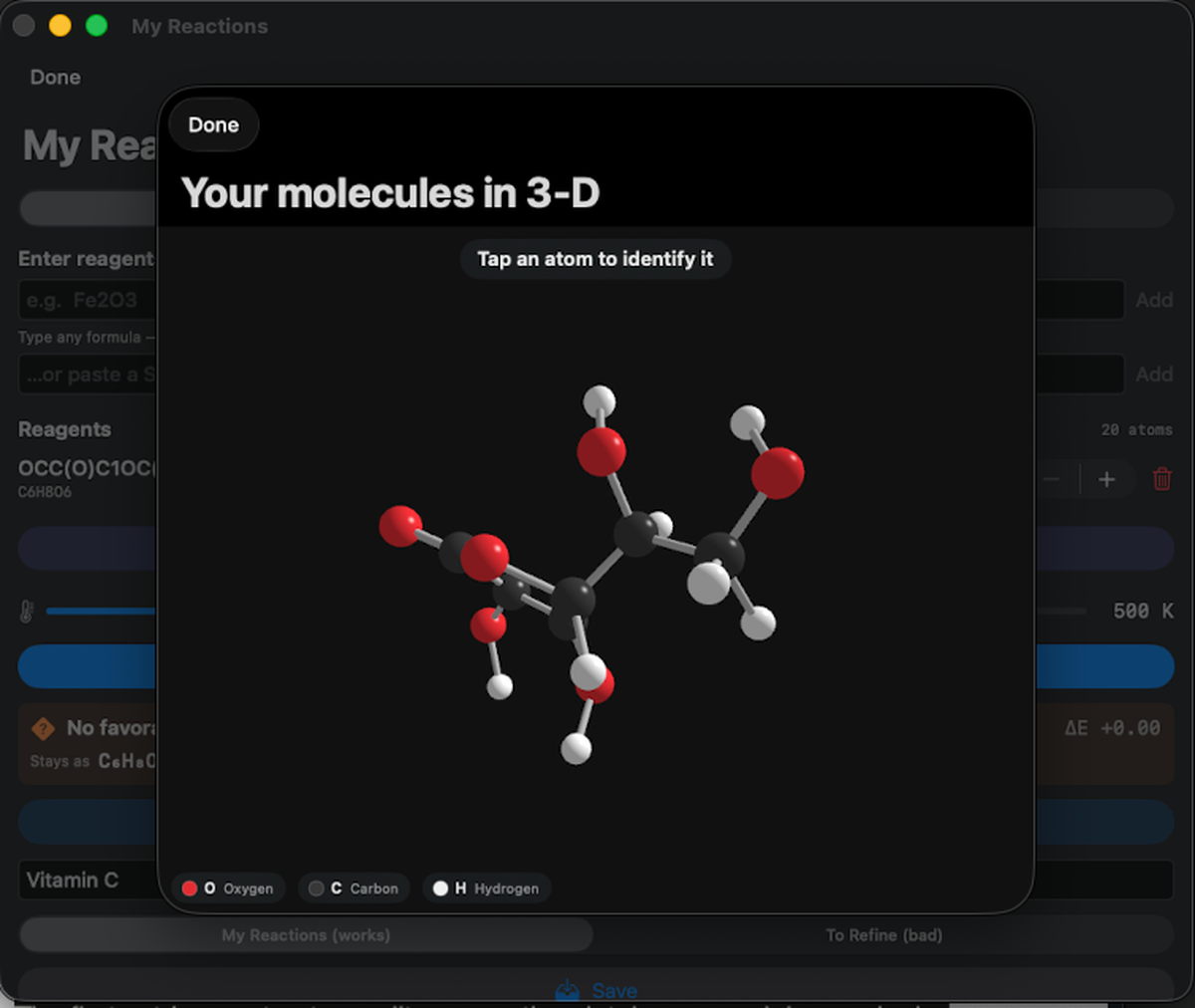
Test your own reactions
Type a formula or paste a SMILES structure — Vitamin C, aspirin, your own molecule — set the temperature, and get the engine's honest verdict with the energy change. Rotate any molecule in 3-D (real geometry, π clouds), ask it to work out a retrosynthesis down to buyable building blocks, or send the mixture to the live reactor to watch it play out. Save what works to your own library and name it; keep the near-misses to refine later. Every saved reaction now carries a portable, self-verifying share code — send one to a colleague and they import the exact reaction, reproduced bit-for-bit and re-checked against the engine.
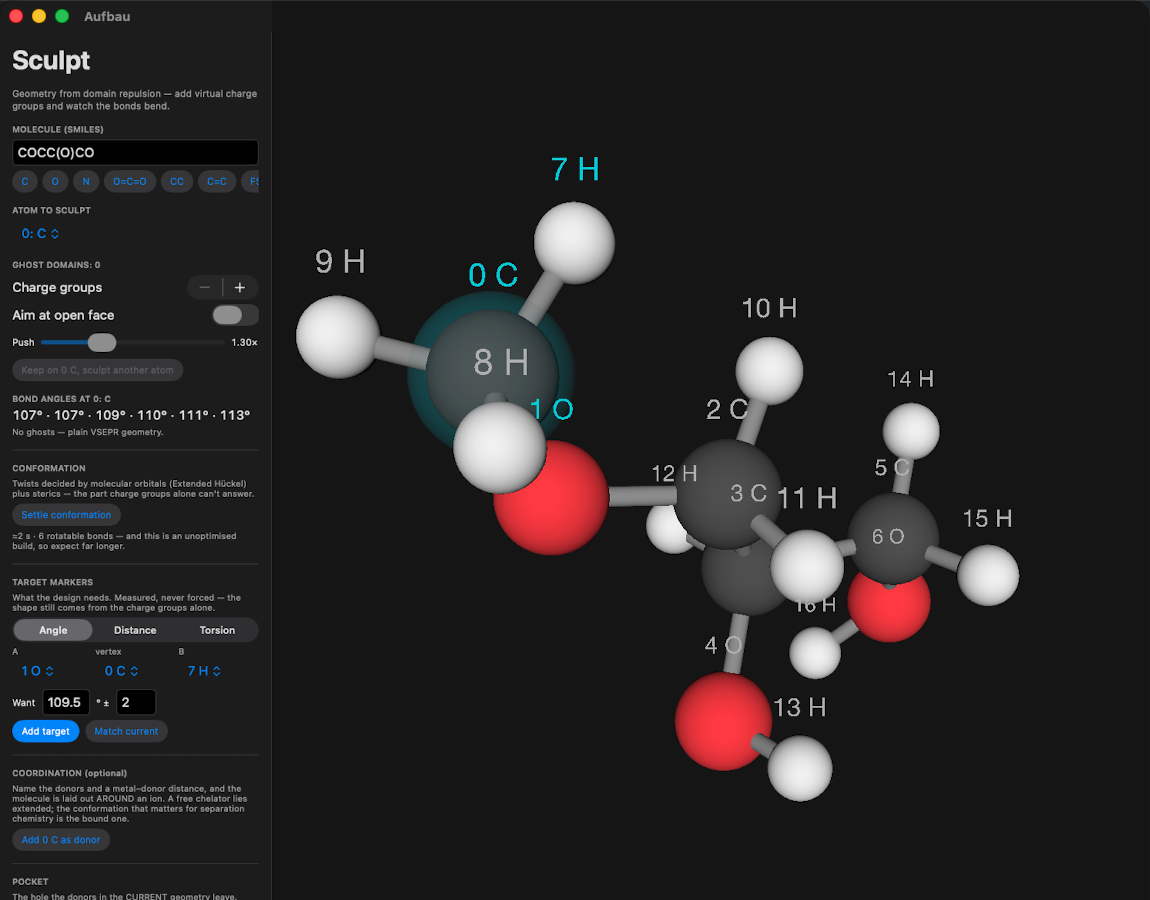
Push back on the geometry
Sculpt lets you ask for a shape — this angle, that distance, this torsion — and reports what the chemistry says it costs. Where a target fights the physics, the physics wins and the tool tells you by how much. New in 1.9.
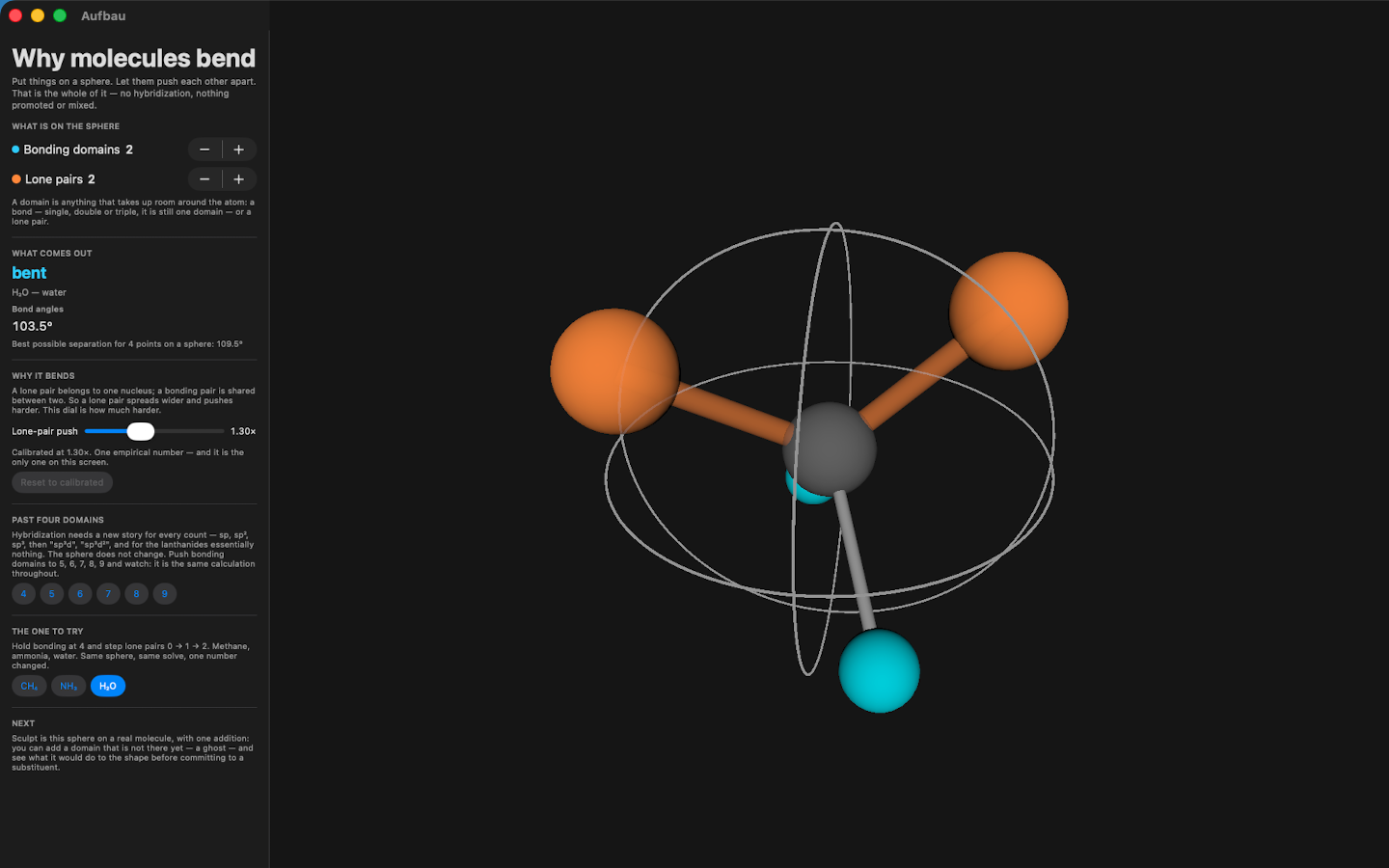
Derive it, don’t memorize it
Short lessons that work a question out rather than stating the answer. Why water bends is put things on a sphere and let them push each other apart — methane, ammonia and water from one calculation, with hybridization never mentioned. Others work through why a mixture will not simply react, and how to plan a synthesis backwards. Every number a lesson shows is computed live by the same engine that answers everywhere else in the app, and you can turn the dials and watch it change. No language model is involved, and nothing is scripted. New in 1.12.
The next generation of computer-assisted synthesis.
Four decades ago, the pioneering LHASA project helped establish computer-assisted synthesis planning. Aufbau founder John W. Miller contributed to that early work with E. J. Corey and colleagues, including research on computer-assisted protective-group selection for multistep organic synthesis.
Aufbau is not LHASA. That first generation encoded expert chemical knowledge in a library of transforms. Aufbau keeps no reaction-transform library: it derives each route from the same energy-based model that builds its molecular structures. It answers the question Corey's group helped place before the computer—but answers it in a fundamentally new way.
Notable publication Corey, E. J.; Long, A. K.; Greene, T. W.; Miller, J. W. Computer-Assisted Synthetic Analysis. Selection of Protective Groups for Multistep Organic Syntheses. J. Org. Chem. 1985, 50 (11), 1920–1927. doi.org/10.1021/jo00211a027 ↗
One engine — all the way to the nucleus.
Chemical bonding and nuclear stability are usually separate subjects, on separate energy scales, with separate software. Aufbau asks both the same question: does this rearrangement release energy?
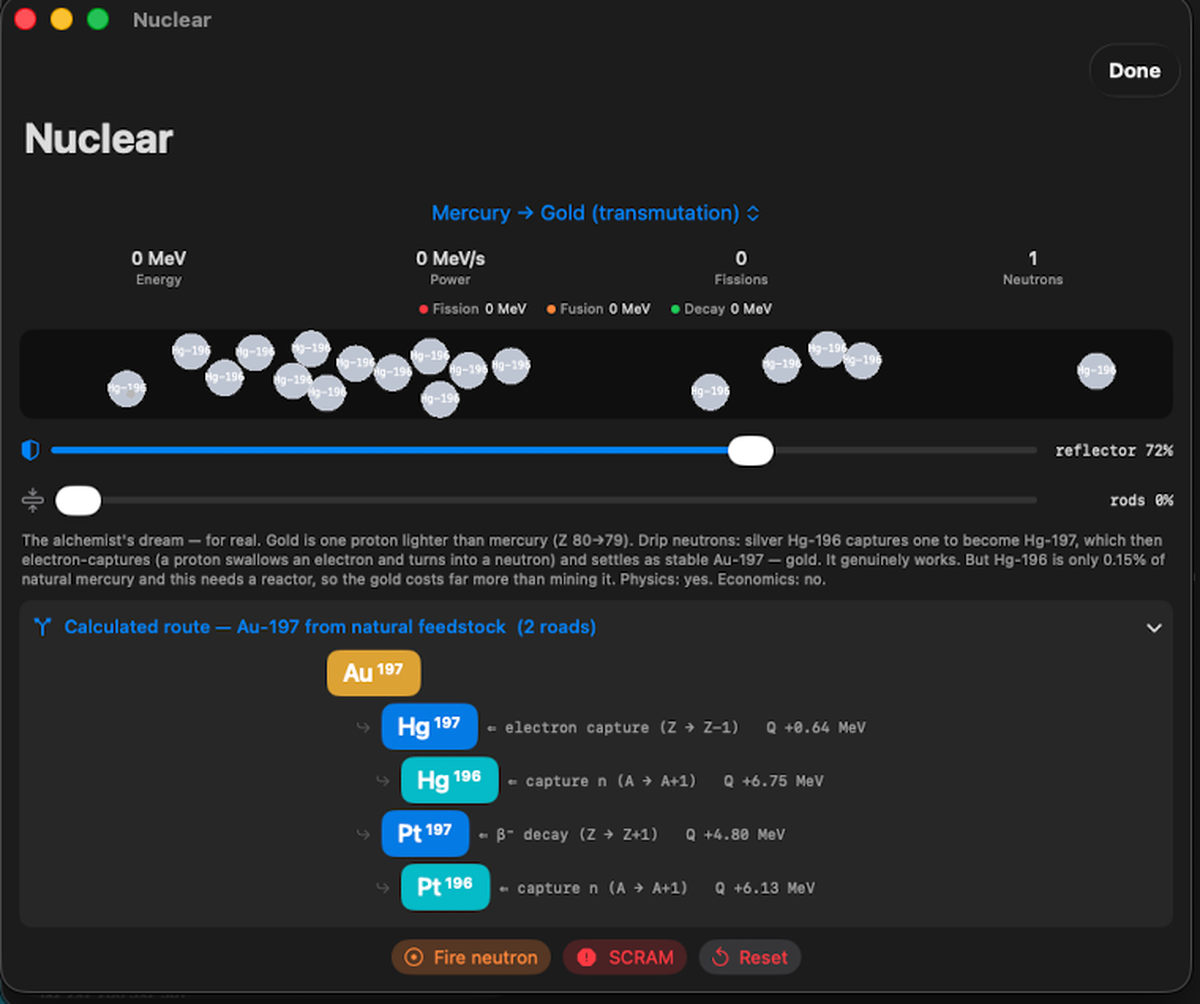
Ask it of electrons and you get chemistry. Ask it of nuclei and you get decay, fission, fusion — and the alchemist's route from mercury to gold, forbidden as a shortcut and forced into its real two-step path by the arithmetic of binding energy.
The honest answers.
Is this a real chemistry engine or just animations?
Real. Structures and reactions are computed from an interpretable bonding model and the semi-empirical mass formula — not retrieved from a database. You can trace any result down to the rule that produced it, including where a simple model reaches its limits.
What platform does it run on?
macOS. Aufbau is a native Mac app — available on the Mac App Store.
Who is it for?
Undergraduate and advanced high-school chemistry — general through introductory organic — plus an optional nuclear-chemistry module. For instructors who want to show why, and students who want to see it.
Does it collect any data?
No. Aufbau runs entirely on your device, collects nothing, and makes no network connections. Details on the Privacy page.
Does it really compute urea from CO₂ and ammonia?
Yes — end to end. Give it carbon dioxide and ammonia and Aufbau derives the two-step industrial path (through carbamic acid to urea and water), with the energy change at each step. It isn't retrieved from a table of known reactions; the route emerges from the same bonding model that builds the molecules. When a mixture won't react, it says so and explains how close it came.
Can it really turn mercury into gold?
In the model, yes — the physics is genuine and the route is forced by binding energy. In reality it needs a reactor and a rare isotope, so the gold would cost far more than mining it. Physics: yes. Economics: no.
Chemistry is just the surface.
Beneath the bonds, Aufbau computes the electronic structure itself — molecular orbitals, unpaired spins, a molecular qubit, an entangled pair. Thirty seconds of the layer underneath.
And the deepest layer of all lives inside a diamond. The tetrahedral carbon the engine already builds in methane is the exact motif a diamond lattice repeats — and that lattice is where a qubit can hide. Swap one carbon for a nitrogen, leave an empty site beside it, and you have a nitrogen-vacancy center: a single electron spin, held in a diamond lattice, that you can drive like a qubit.
Sweep a magnetic field across it and the NV's two spin resonances slide apart from their ≈2.87 GHz zero-field splitting — the Zeeman term γ·B pushing one up and the other down. The gap between them is the field: an atom-sized magnetometer that reads in frequency. Every frame is computed live from the measured constants D and γ — nothing scripted, nothing keyframed.
That's the thread the whole app is built to follow: the bond that assembles a molecule, the same release-of-energy question asked of a nucleus, and — deeper still — the spin of a single defect answering a magnet. One app, following matter without a seam from a chemical bond down to the quantum layer beneath it.